Newsletter Subscribe
Enter your email address below and subscribe to our newsletter

 Bygonzay
Reliable network connectivity is essential for businesses that depend on computers, communication systems, security equipment, and digital services. Whether an organization operates a small office, retail store, warehouse, or commercial building, its network infrastructure plays an important role in supporting everyday operations.
As technology continues to advance, businesses require network connections capable of supporting increasing data demands. Poorly organized cables, outdated wiring, and unsuitable network installations can create performance problems and make maintenance more difficult.
Understanding the importance of professional cabling infrastructure can help Chicago businesses improve connectivity, maintain organized communication systems, and prepare for future technological requirements.
Network cabling infrastructure consists of cables, connectors, patch panels, telecommunications rooms, and related components that support data transmission throughout a building.
A properly designed system provides organized connections between computers, networking equipment, communication devices, and other technologies.
Horizontal cabling connects telecommunications rooms to network outlets located throughout a building.
These connections commonly serve office workstations, meeting rooms, and other business areas.
Backbone cabling connects different telecommunications rooms, building floors, or separate facilities.
Fiber optic cables are frequently used for backbone connections because of their transmission capabilities.
Telecommunications rooms contain equipment and connections used to manage a building’s network infrastructure.
Organized layouts help technicians identify connections and perform maintenance efficiently.
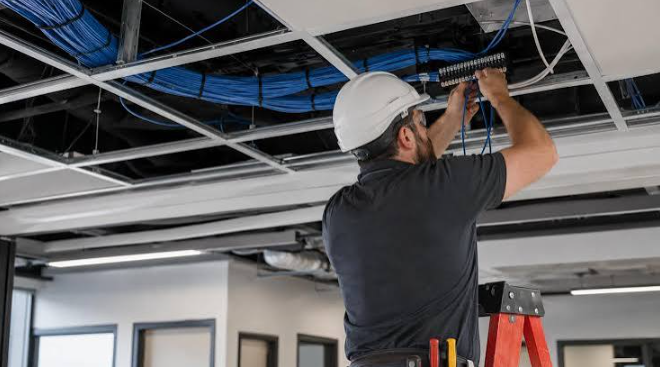
Patch panels provide centralized locations for organizing and managing cable connections.
Proper labeling simplifies troubleshooting and future modifications.
Modern commercial operations depend on stable connections between employees, equipment, and digital applications.
An unreliable network can interrupt communication and reduce operational efficiency.
Professional network cabling provides several important advantages:
A carefully planned installation can help organizations maintain reliable connections as their technology requirements change.
Poorly maintained or outdated cabling installations can create several technical challenges.
Unlabeled cables and tangled wiring make it difficult to identify network connections.
This can increase troubleshooting time and complicate equipment replacement.
Cables may become damaged because of excessive bending, physical pressure, improper handling, or environmental exposure.
Damaged connections can affect network performance.
Older cable installations may not support the transmission speeds or equipment requirements of newer network technologies.
Professional assessments help identify potential limitations.
Cables installed without suitable pathways may be exposed to damage or interfere with maintenance activities.
Missing labels and inaccurate connection records can create confusion during repairs or expansion projects.
Businesses should evaluate their network infrastructure when experiencing recurring connectivity problems or planning significant technology improvements.
A professional structured cabling Chicago service can help organizations assess existing installations, organize communication infrastructure, and design cabling systems suitable for current and future operational requirements.
Professional technicians can review cable conditions, connection arrangements, and network equipment requirements before recommending improvements.
Not every connectivity problem requires complete cabling replacement. Some issues can be resolved through connector repairs, equipment adjustments, or individual cable replacement.
Proper planning helps businesses create network infrastructure suitable for their operational needs.
The number of floors, office areas, meeting rooms, and equipment locations influences cable routing and network design.
Businesses should consider computers, printers, security cameras, wireless access points, and other connected devices.
Different applications require different network speeds and bandwidth capabilities.
Additional employees, departments, and equipment may increase network connection requirements.
Appropriate routing protects cables from physical damage and supports organized installation.
Cabling systems should follow applicable telecommunications standards, building regulations, and manufacturer specifications.
Different networking environments require different cable technologies.
Category 5e cables can support Gigabit Ethernet applications within specified installation limits.
Their suitability depends on network requirements and cable condition.
Category 6 cables provide improved transmission performance compared with earlier categories under their applicable specifications.
They are commonly used in commercial networking installations.
Category 6A cables are designed to support 10 Gigabit Ethernet over standard twisted-pair Ethernet channel distances when properly installed.
They can be suitable for businesses planning higher-performance network infrastructure.
Fiber optic cables transmit information using light.
They are widely used for high-speed connections, backbone networks, and applications requiring longer transmission distances.
Professional technicians help ensure that network cabling is installed and organized correctly.
Technicians evaluate existing network connections, cable pathways, and equipment requirements.
Cable routes and connection points are planned according to the building layout and operational needs.
Suitable cables are installed using methods that protect their performance and physical condition.
Network cables are terminated using compatible connectors and components.
Appropriate testing helps confirm that installed cabling meets the required performance specifications.
Different commercial properties have unique networking requirements.
Office environments require reliable connections for workstations, conference rooms, printers, and wireless access points.
Retail businesses may depend on network connections for payment systems, inventory equipment, and security cameras.
Warehouses often require networking infrastructure for inventory systems, scanners, wireless devices, and surveillance equipment.
Healthcare environments rely on connected equipment and communication systems that may require specialized infrastructure planning.
Schools and training centers may need extensive network connections for classrooms, administrative offices, and wireless access points.
Proper cable management improves network organization and simplifies maintenance.
Labels help technicians identify network connections quickly.
Suitable cable management equipment helps keep patch panels and networking devices accessible.
Network cables should be routed according to applicable requirements for separation from electrical power wiring and potential interference sources.
Excessive bending can affect cable performance or damage internal components.
Updated records help businesses manage future repairs and expansions.
Poor installation practices can affect network reliability and increase maintenance requirements.
Cables should be selected according to performance requirements and installation conditions.
Copper Ethernet cabling must follow applicable channel length specifications.
Incorrectly terminated connectors can create transmission errors and unstable connections.
Moisture, temperature, and physical exposure can affect cable performance.
Professional testing helps identify wiring faults and performance limitations before the system enters regular operation.
Regular maintenance helps businesses preserve reliable network connections.
Visible damage, crushed cables, and loose connections should be professionally evaluated.
Network rooms should remain clean, accessible, and appropriately ventilated.
Connection labels should be revised whenever network changes occur.
Cable pathways should prevent unnecessary pressure, sharp bends, and accidental impacts.
Qualified network technicians can identify deteriorating components and recommend suitable improvements.
A properly designed cabling system provides a foundation for dependable business communication.
Organized connections help reduce troubleshooting complexity and support efficient equipment maintenance.
Suitable cable categories and fiber optic infrastructure can also help businesses accommodate faster networking technologies when compatible equipment is introduced.
Planning for future expansion may reduce unnecessary installation work when additional workstations or network devices are required.
Accurate documentation and regular maintenance further support long-term infrastructure reliability.
Reliable network cabling infrastructure is an important part of modern business operations. Computers, communication systems, security equipment, and digital applications depend on stable network connections to function effectively.
Chicago businesses can improve network reliability by evaluating existing cabling conditions, choosing suitable technologies, and maintaining organized communication infrastructure.
With professional planning, appropriate installation methods, thorough testing, and preventive maintenance, commercial properties can support dependable connectivity while preparing for future networking requirements.