Newsletter Subscribe
Enter your email address below and subscribe to our newsletter

 Bygonzay
A bridal necklace can look simple from a distance. Up close, it is a map of skills. Gold foil, enamel, stone setting, and hand polish all sit within a few square inches. Traditional Indian jewelry techniques shape the look of every wedding set, and knowing them helps you read what you are wearing or buying.
The history of Kundan craftsmanship is closely tied to Indian royal courts. The technique became well known in Rajasthan, where rulers supported workshops that made jewelry for the palace. Mughal taste also influenced the style, with its love of precious stones and fine detail.
Exact dates are hard to fix. Some sources trace related methods back further, but the form we see today grew strongly between the 16th and 18th centuries. Jaipur became a major center, and it still holds that role.
Stories say that rulers brought skilled enamel workers to their courts. This is one reason Kundan and meenakari often appear together in the same piece.
The traditional Indian gemstone setting differs from the claw settings common in Western jewelry. Instead of metal prongs gripping a stone, many Indian methods build a thin wall of gold around it.
In Kundan, a pure gold foil strip is pressed around the stone to hold it in place. In jadau, the broader tradition that includes Kundan, stones are set into a lac-filled frame. The setter works by hand, using small tools to shape each edge.
Uncut diamonds, called polki, work well with this method because their flat, irregular surfaces sit smoothly in foil. Colored stones like emerald and ruby are set the same way.
The Kundan jewelry making process takes many steps, and each step has its own expert.
First, a designer sketches the pattern. A goldsmith then makes the base frame, called the ghat, from gold or silver. Next, the frame is filled with lac, a natural resin, which holds the stones while they are set.
The setter then presses each stone into the lac and shapes strips of gold foil around it. The foil is thin and soft, so it takes a steady hand. Once the setting is done, the metalworker removes extra lac and cleans the back.
After that, many pieces move to an enameler, who adds color to the reverse side. A final polish brings out the shine. The whole process can take days or weeks, depending on the size of the piece.
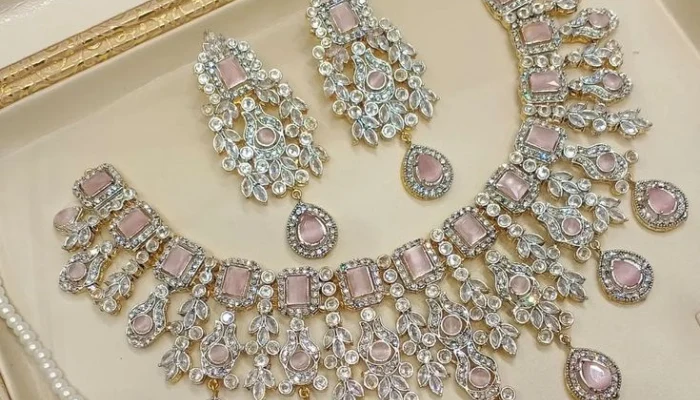
A well-made set of Indian kundan jewelry shows these steps clearly in its smooth settings, even edges, and clean backs.
Heritage jewelry designs follow patterns that have lasted for centuries. Floral motifs, peacocks, paisleys, and lotus shapes appear again and again. They come from temple carvings, palace walls, and textile prints.
Different regions keep different favorites. Rajasthani work leans toward peacocks and floral vines. South Indian temple jewelry features gods, goddesses, and sacred symbols. Bengali designs often use delicate gold wire and fine patterns.
These motifs tie each piece to a place. A trained eye can often guess where a necklace came from by looking at its shapes alone. Heritage designs also gain value over time because they link to real traditions, not passing trends.
Traditional bridal ornament craftsmanship has to meet high standards. A bridal set will be worn for hours, photographed from many angles, and often kept for decades. Weak joints or loose stones are not an option.
Makers pay attention to weight balance. A large necklace must sit properly on the collarbone. Heavy earrings need good support. Headpieces need secure chains so they do not slip.
The back of the piece matters too. Good makers smooth every edge, because rough metal can scratch skin or catch on fabric. Many pieces also include small hooks and adjustable cords so they fit different necklines.
Much of this work shows up in Indian bridal jewelry, where each set is built to last through the ceremony and beyond.
Indian jewelry design traditions continue to shape new work. Many modern makers use old patterns in lighter forms. Some blend meenakari with simple silver. Others use Kundan stones in clean, geometric shapes.
Respect for the source matters. Designers who study old pieces tend to produce better work, because they understand why each detail exists. A stone is placed in a certain spot for balance, not just looks. A curve follows the way the piece sits on the body.
These traditions also pass through apprenticeships. A young artisan often spends years learning one step, such as setting or polishing, before moving to the next.
A few simple checks help when you look at a piece. Turn it over and study the back. Clean, even work suggests careful making. Look at the edges of the settings. They should be smooth and tight around each stone.
Check the weight and balance. Hold a necklace or earrings and see how they hang. Test the clasps and hooks. Ask about the materials and where the piece was made.
Do not expect machine-level sameness. Hand work shows small differences, and that is part of its value. What matters is overall care.
Traditional Indian jewelry techniques give bridal designs their depth. Kundan setting, enameling, and detailed metalwork each add a layer of skill, and together they turn gold and stone into something meant to be worn and kept.
Next time you look at a bridal set, check the settings, the back, and the pattern. Each one tells you how the piece was made, and by whose tradition.